When the Founder Becomes the Operating System
TL;DR
Adding capable AI agents increased productivity at Lucimark, but I still had to carry context, reconcile conflicting versions of reality and restart stalled work. The bottleneck was not intelligence; it was organizational continuity. Lucimark OrgOS emerged from investigating how state, evidence and work can persist across people, agents, tools and time. The goal is to preserve human judgment and authority while removing the founder from avoidable coordination work.
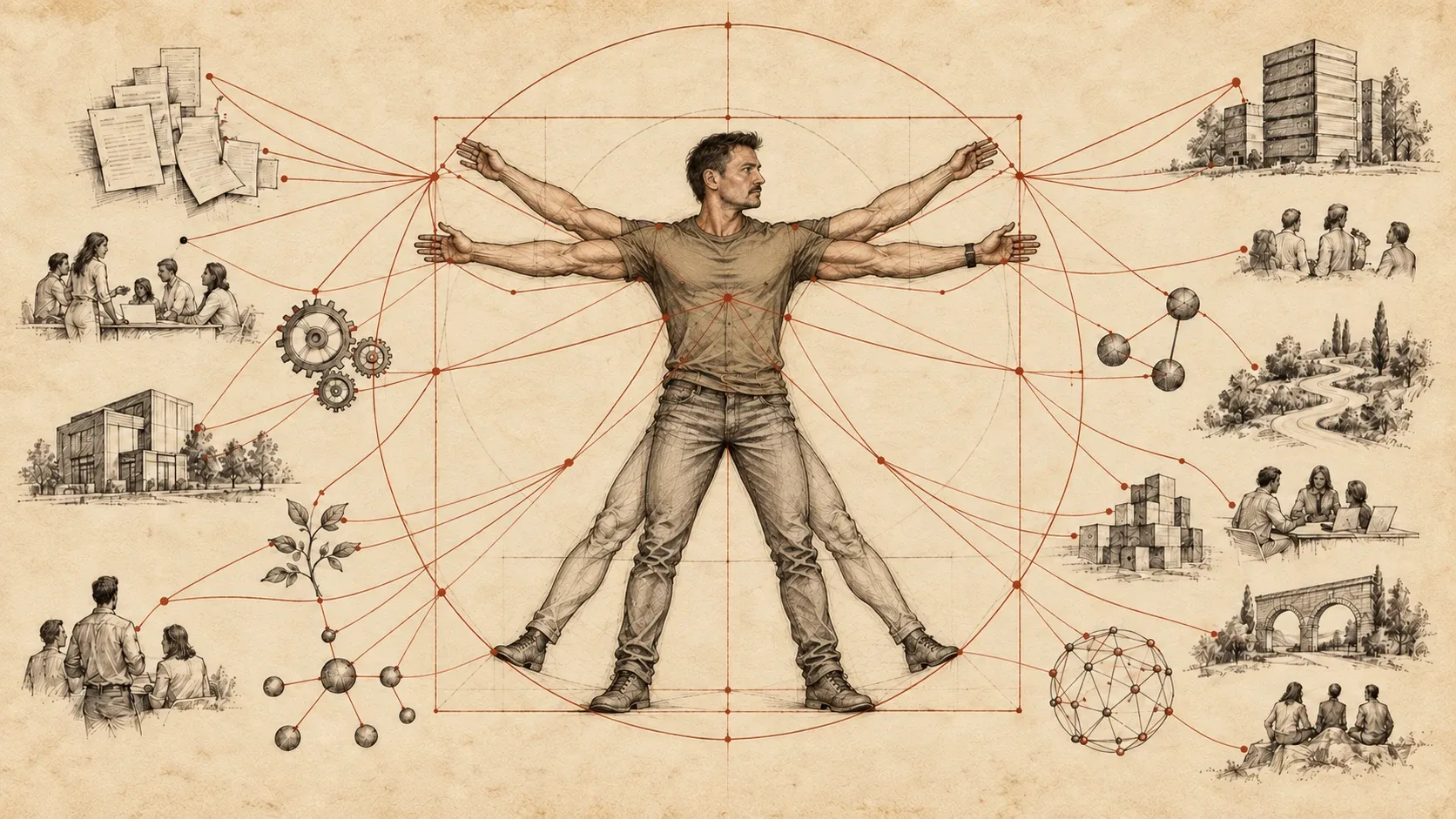
While trying to make Lucimark less dependent on me, I realized something uncomfortable: I was not merely running the company.
I was part of its infrastructure.
Lucimark is the infrastructure company for operators of digital screen networks that I am building.
Lucimark already had code, documents, customers, cloud systems and AI agents capable of investigating problems, writing software and helping with product and operational decisions. The agents made more work possible in parallel. Yet if I stepped away, parts of the organization still came apart.
I remembered which decision was current, carried context between conversations, reconciled conflicting accounts of reality and noticed when work should have resumed. The agents could do useful work, but I still had to keep the whole operation coherent. Adding intelligence had not given the organization continuity.
I had added agents. But in many places, the operating system was still the founder.
The agents worked — and that was the problem
I did not set out to build an “operating system for organizations.” As in most small companies, Lucimark had more work than people. Agents naturally helped with engineering, product, customers and planning. Their productivity was real. Precisely because they worked, they exposed a layer of human work I had barely noticed.
In one case, a technical change had been completed and there was evidence for it. Elsewhere, the organizational state still described the old reality. Nothing was locally broken; two versions of reality coexisted.
In another case, a condition for continuing work was satisfied, and nothing happened. I noticed the stalled process and restarted it myself.
Together, those incidents revealed the gap: local capability does not create global continuity.
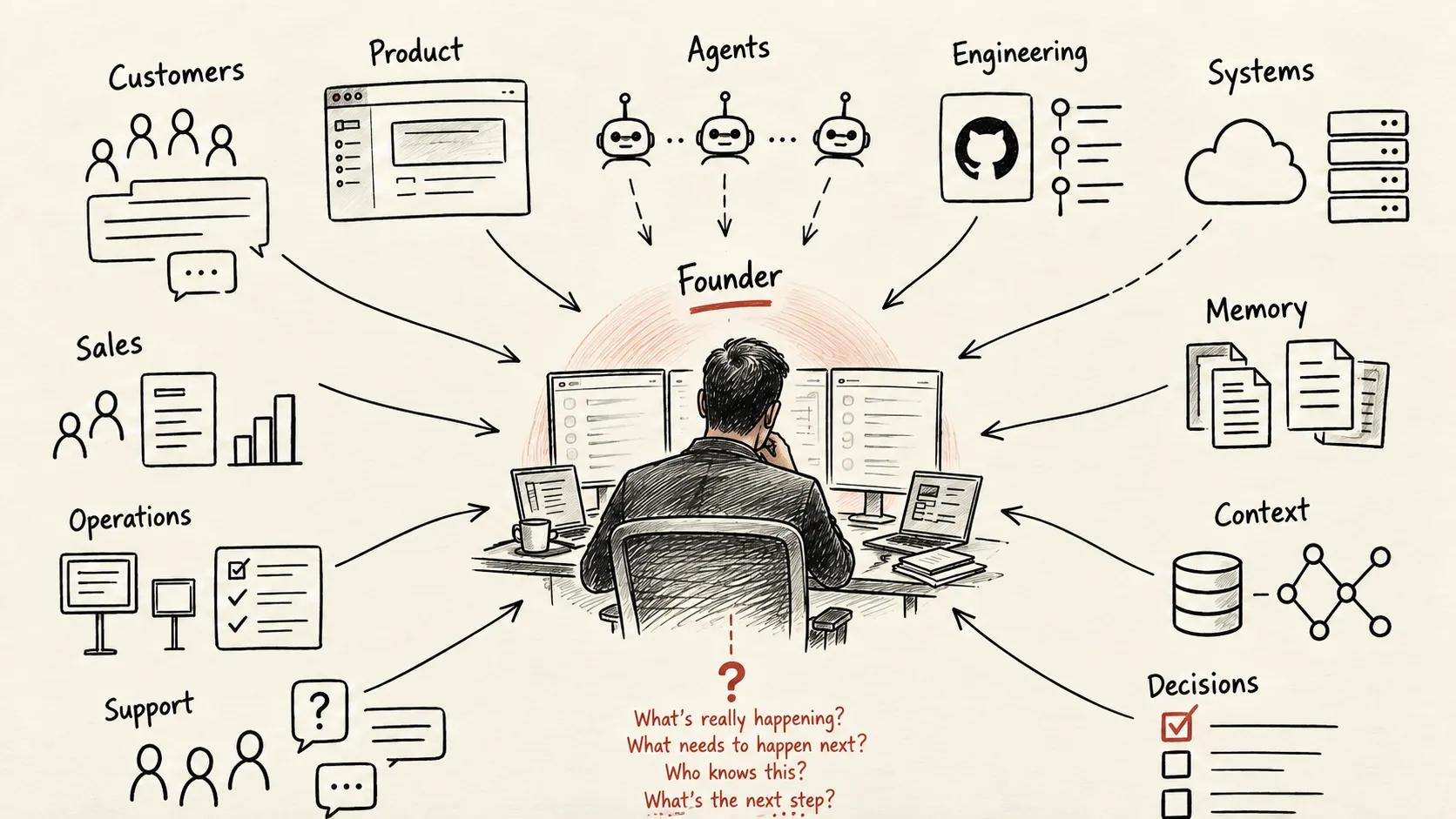
A seemingly trivial question became surprisingly important: What is true now? I answered it many times a day—whether a decision had been superseded, an implementation had happened, a claim was verified or a process had stopped. Inside my head, this felt like ordinary attention. Seen as a system, it was infrastructure.
The founder as middleware
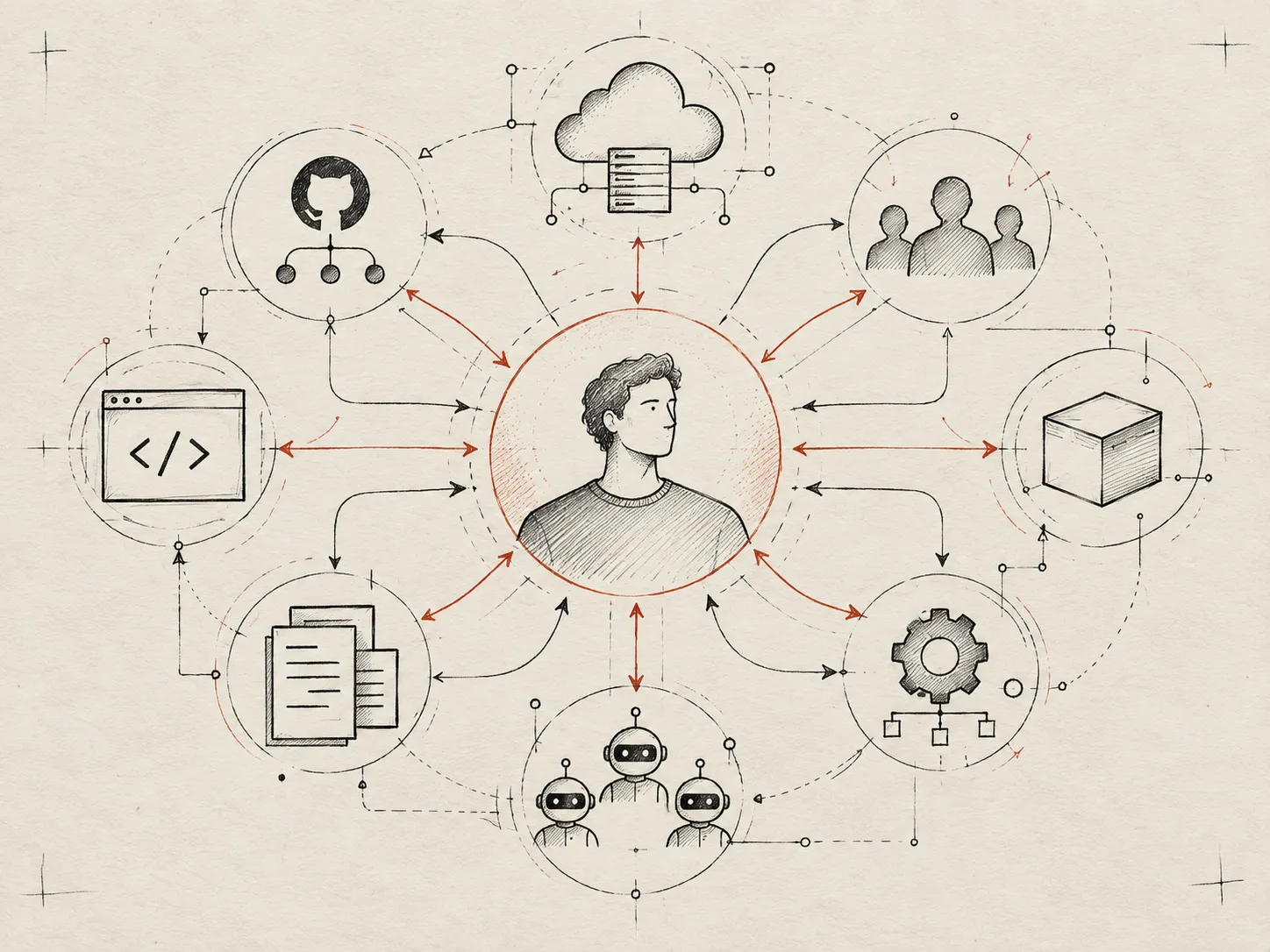
A founder defines direction and accepts responsibility. In a small organization, the same person often performs a quieter job: joining systems that do not yet join themselves. A customer request changes an engineering priority. One agent’s conclusion must reach another. A decision made weeks ago prevents settled work from reopening. An external event should wake a suspended process.
When these connections depend on one person, the founder becomes part of the machinery that keeps the organization coherent. I wanted to remove that dependency while keeping the judgment and responsibility that genuinely belong to a person.
Leadership is not middleware.
Remembering that work finished is different from deciding what work matters. Transporting context is different from exercising authority. Mixing those functions makes every intervention look like leadership, even when the organization simply lacks a way to maintain its own state.
Human authority is not human intervention
Some choices should belong to an accountable person: strategic direction, financial commitments, consequential product decisions and actions that are difficult to reverse. Those are not failures of automation. They are authority, and authority is as much a part of organizational architecture as code or state.
But much of my daily participation belonged to a different category.
I was not deciding. I was remembering.
I was not exercising authority. I was transporting context.
I was telling an agent that an event had already happened, reconciling two records or noticing that a process had stalled. From outside, both kinds of situation looked like “the founder had to intervene.” Structurally, one was necessary human authority; the other was avoidable human intervention. The first needs to be explicit. The second often points to missing infrastructure.
That distinction changed my question from “How do I get agents to do more?” to “How does an organization maintain coherent state and pursue an intention across people, agents, tools and time?” It led to what I now call Lucimark OrgOS—an investigation, rather than a finished product.
What remains when the agent is gone?
An agent can finish excellent work and leave no reliable organizational memory behind. What happened, and what evidence supports that claim? What remains unknown? Which work should continue, and who has authority to act? Where does the operational reality of the organization live?
It cannot live solely in an agent’s conversation, a document, GitHub or the founder’s head. Each holds part of the picture. The organization needs state that survives the actor who produced it: what was intended, what work was attempted, what happened, who observed it, what evidence exists and what remains uncertain.
We began distinguishing intention, work, action, observation, evidence and outcome because we kept blurring what we wanted to happen with what had actually happened. An agent then becomes an actor inside an organization with its own continuity, rather than the place where the organization’s reality lives. Agents can come and go; the distinction between what the organization knows, believes and does not know must remain.
From intention to reality
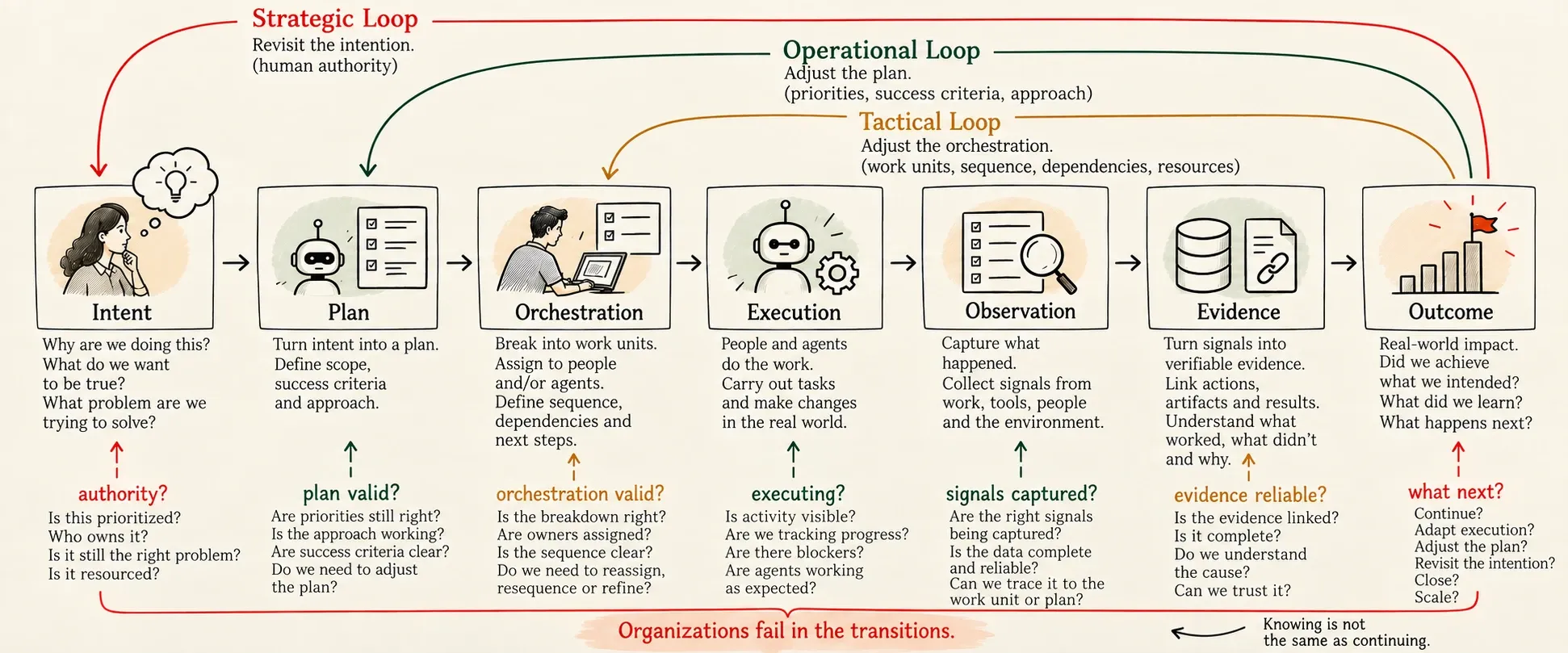
An organization tries to make something true in the world. An intention leads to a plan and work; work produces actions; reality responds; the organization observes the result. The difficult parts are the transitions. An action may happen without being observed. Evidence may arrive without waking the work that depends on it. An outcome may change reality while the recorded state stays the same.
Much of my “coordination” was human repair of those gaps. The two failures I had seen were different: in one, reality changed without the organization updating what it knew; in the other, the organization knew the condition for continuing but did not act. Knowing is not the same as continuing.
An intention can also exist without work, work without sufficient authority, and an observation without evidence. Even a system that is internally consistent can drift away from the world if it has no way to detect and resolve those breaks. The point of the vocabulary is to make each transition inspectable, not to give ordinary work grander names.
Feedback has a destination
At first, I pictured feedback as a single loop: observe, learn, adjust. But adjustment has to return to the decision that can change something. The model we are testing has three paths:
- The tactical loop returns to orchestration. If a task stalls or goes to the wrong actor, it can be retried, reassigned or resequenced while the plan remains valid.
- The operational loop returns to the plan. If the approach fails or priorities change, it revises the approach or success criteria while keeping the intention.
- The strategic loop returns to the intention. When the assumptions were wrong or the problem is no longer worth solving, it asks whether the organization is still pursuing the right outcome.
None returns to observation. Observation tells us what happened; it cannot decide what should change. A system that only records more facts gains awareness without gaining the ability to adapt.
These paths also clarify authority. Tactical adjustments can often happen within boundaries already approved by a person. Material changes to a plan may require more explicit governance. Changing the intention should normally involve accountable human judgment, even if the system presents evidence and proposes a direction. This is a design principle we are testing, not a universal rule. But it described my own days uncomfortably well: most of what I had been doing by hand was tactical, and very little of it required my authority.
The stalled process from earlier usually calls for a tactical response: resume or reassign the next work unit, rather than reconsider the goal. When reality and organizational state diverge, the state first needs to be reconciled with evidence. Then the organization has to decide whether that correction affects current work, the plan or the intention. Updating the record alone is insufficient.
I had been doing that routing myself. A system that observes a change but cannot send it to the right decision point has awareness, not adaptation. If only the founder can route it, the ability to adapt still depends on the founder.
Building in order to discover
We are building a runtime where organizational state persists independently of agents, observations have provenance and unknowns are represented explicitly. It distinguishes when something happened from when the system learned about it—and both from why it happened. Sequence alone is not proof of cause. We are also making boundaries between reading, writing, execution and authority explicit.
Building does not prove that this is the right architecture. It makes our hypotheses concrete enough to fail in observable ways.
When everything lives inside someone’s head, an organization can run on a remarkable amount of silent correction. Humans remember what was never recorded, infer what someone meant, reconcile systems and restart processes. An organization can operate for years on mechanisms nobody formally built, until we try to remove one of those people from the path.
That is what the agents did to me. They did not replace me. They made my invisible functions easier to see.
My background in military communications and enterprise systems may have made me sensitive to this. A message has an origin, a sequence, an authority and a need for confirmation. Only when agents exposed what I had been carrying did I start applying the same reasoning to the organization itself.
Taking the founder out of the runtime
I want to make decisions that require my authority and change my mind when evidence warrants it. I do not want to be the message bus, persistent memory, scheduler or reconciliation process. In terms of the three loops, I expect to retain authority over strategic changes, participate when a plan changes materially and stop being the mechanism that keeps tactical work moving.
That is what autonomy means in this investigation. Not an organization that acts without humans, but one able to continue through transitions it understands without requiring a person to carry its state between them. Authority can remain human. Continuity should not depend on one person.
Perhaps that is the simplest test for organizational infrastructure worthy of the name. Not whether it can remove the human, but whether it can make clear when the human is there to exercise authority—and when the human is only compensating for the absence of a system.
I do not yet know whether “organizational operating system” is the right name or where the investigation ends. The question is no longer whether agents can do useful work. They can. It is whether an organization can remember, observe, adjust at the right point and continue when the founder steps out of the path.
We can add as many agents as we want. If the founder still has to carry state between them, reconcile their realities and wake up the work that stopped, we have built an organization with more agents.
The operating system is still a person.
A question to take with you
Where are you exercising judgment—and where are you carrying context that a system should preserve?