What an Organizational Operating System Actually Looks Like
TL;DR
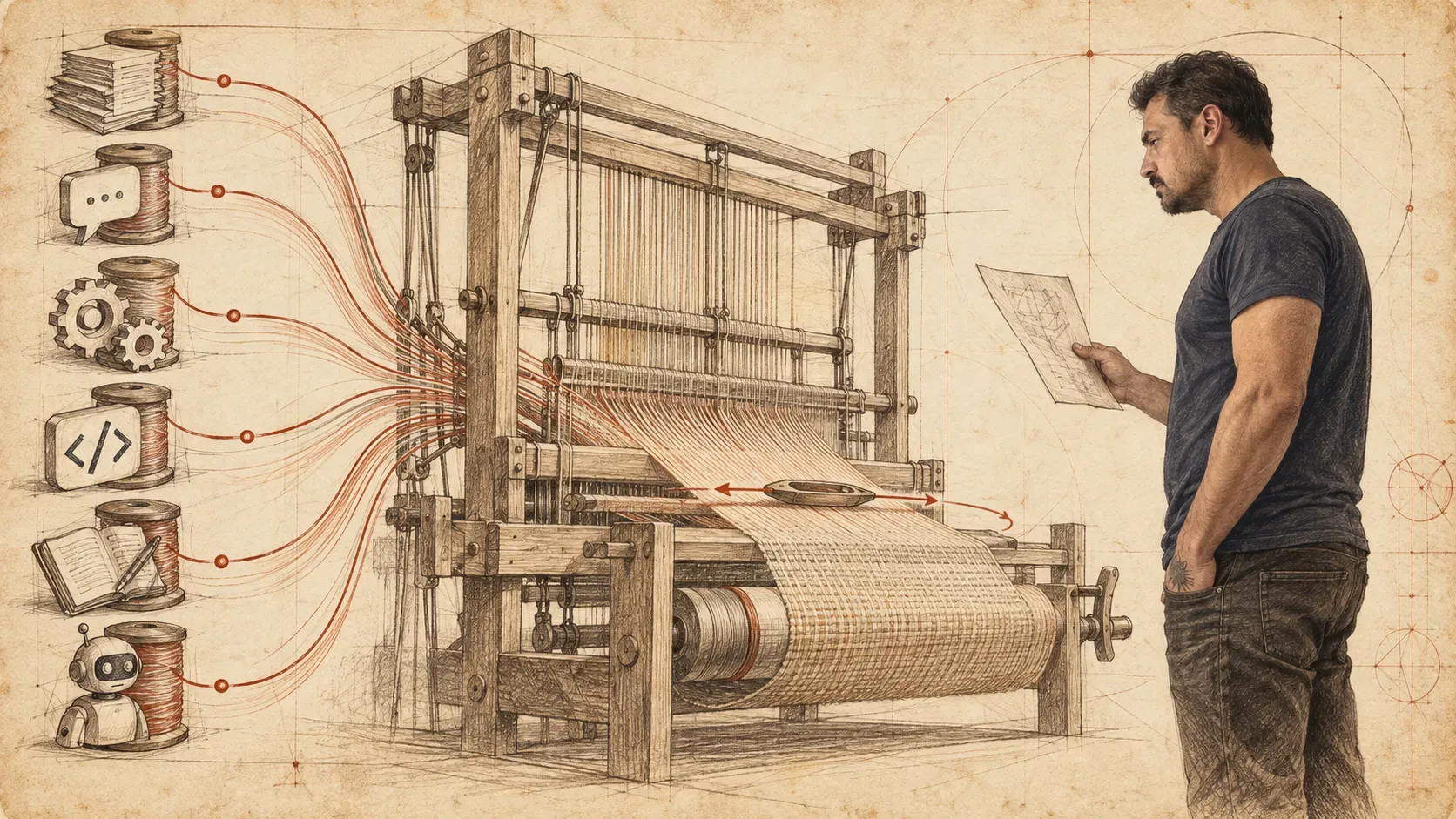
An organizational operating system is not a new place to work. It sits above the tools a company already uses and keeps a traceable account of what the organization is trying to make true, what is happening, why it believes that, and what should happen next. Following one intention, reducing enterprise churn, shows how: state instead of memory, observations with provenance, and feedback routed to the right decision point, with routine transitions inside boundaries people set in advance.
In the first essay of Opus Naturalis, I described a problem that only became visible after AI agents started working surprisingly well inside Lucimark. Local capability went up. Organizational continuity did not keep pace. Someone still had to know which information was current, carry context between systems, and restart work that had silently stopped.
That someone was me. The founder was still part of the infrastructure.
That essay ended with a question and a tentative name: Lucimark OrgOS, an organizational operating system. But that phrase is abstract, and abstraction is cheap. So: what would one actually look like?
It is not another place to work
The first thing I had to stop doing was imagining an OrgOS as another application.
Organizations already have plenty of applications. Slack holds conversations, GitHub holds software work, Notion holds documents, CRMs hold customers. AI agents increasingly operate across all of them.
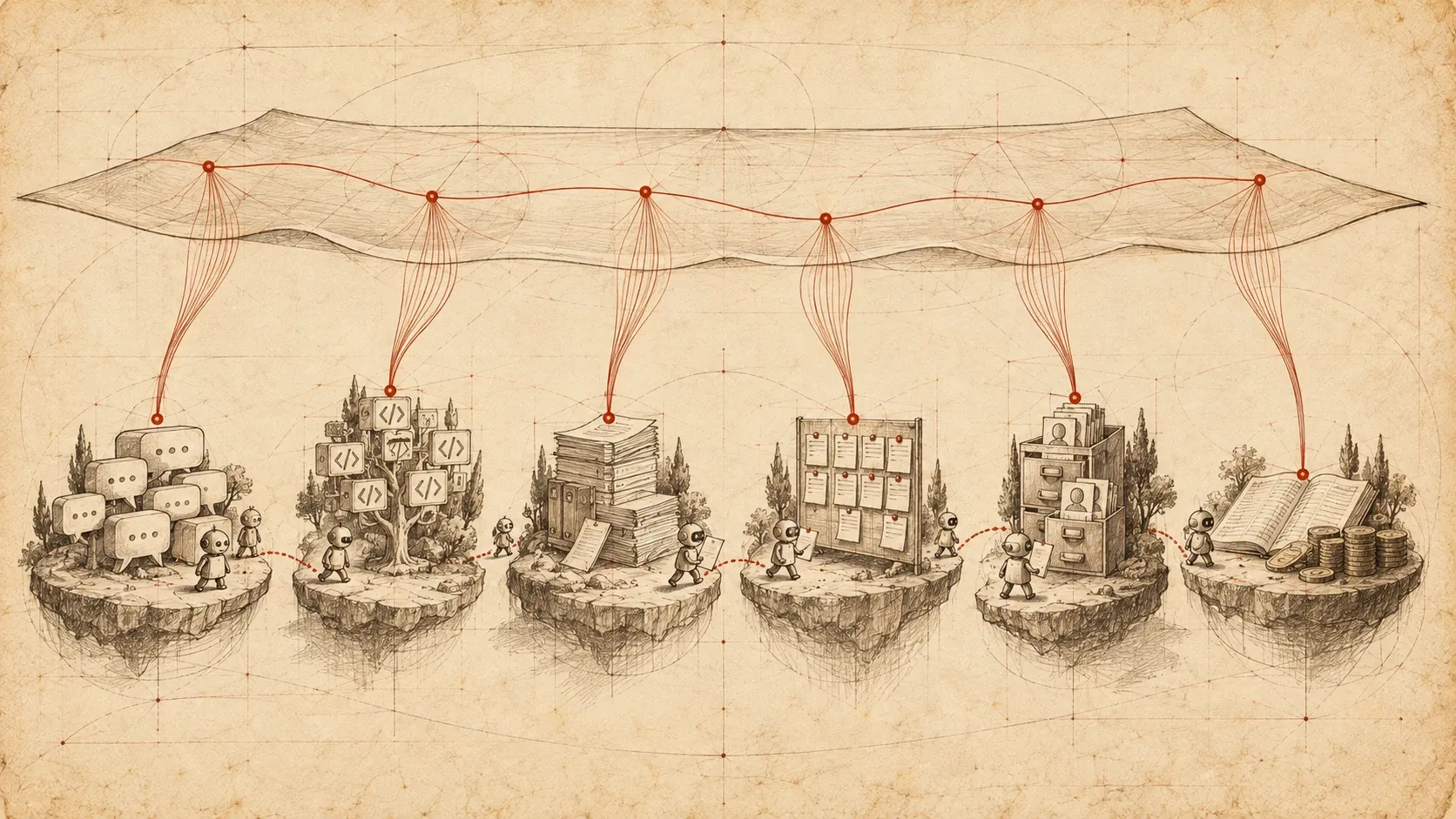
What is missing is not another interface. It is that none of these systems, on its own, represents the organization as something that continues.
A decision can exist in a conversation and never become part of operational state. An agent can finish exactly what it was asked to do while nothing triggers the next step.
In the model I am testing, an OrgOS sits above this fragmentation. It does not replace the tools. It gives their activity organizational meaning.
One intention, followed all the way
The easiest way to show this is to follow one intention from start to finish. The example below is illustrative, not a Lucimark case, but its failures are the kind I described in the first essay.
Imagine a small software company with five people and three AI agents. The founder writes one sentence:
Reduce enterprise customer churn.
That sentence is not yet work. It is a desired change in reality, an intent.
The company turns it into a plan: interview recently lost customers, find the most common causes of churn, improve onboarding and measure whether retention improves.
The plan is not yet work either. Orchestration turns it into coordinated units: one person owns the interviews, an agent analyzes historical support conversations, another person reviews onboarding, a coding agent prepares a product change.
Then comes execution: interviews happen, code gets written. Most existing tools are already good at this part. The interesting problem starts afterward.
The support-analysis agent finishes. That completion is an observation: something the organization now has reason to believe happened, recorded by someone or something at a particular moment. The report, the conversations it read and the queries it ran may become evidence: what makes the observation’s claims traceable. Neither of these says that churn went down. That is an outcome question, and the answer will take months.
So the full path looks like this:
Intent → Plan → Orchestration → Execution → Observation → Evidence → Outcome
This is the path from the first essay, in deliberately plain words; the runtime model is more formal, and its terms do not map one to one onto these. Here I want to show what happens when reality pushes back on it, because it always does.
An interview gets cancelled. The customer stops responding. Nothing about the plan is wrong, and nothing about the intent. The work unit just needs to be rescheduled, reassigned or replaced with the next customer on the list. This is the tactical loop. It returns to orchestration. Within boundaries set in advance, it should often happen without anyone stepping in.
The interviews contradict the plan. Six of eight lost customers say onboarding was fine. They left because a competitor integrated with a tool they already used. The intent still holds. But the onboarding workstream is now built on a false premise. This is the operational loop. It returns to the plan. A system could surface the contradiction and propose a revised plan; whether that revision proceeds on its own depends on the authority boundaries around the plan. Stopping a whole workstream is probably a decision someone should own.
The evidence questions the intent itself. The full picture shows that the enterprise segment costs more to retain than it brings in. Now the question is no longer how to reduce churn. It is whether the company should still be trying to. This is the strategic loop. It returns to the intent. A system can bring the evidence forward, but that decision belongs to accountable human judgment.
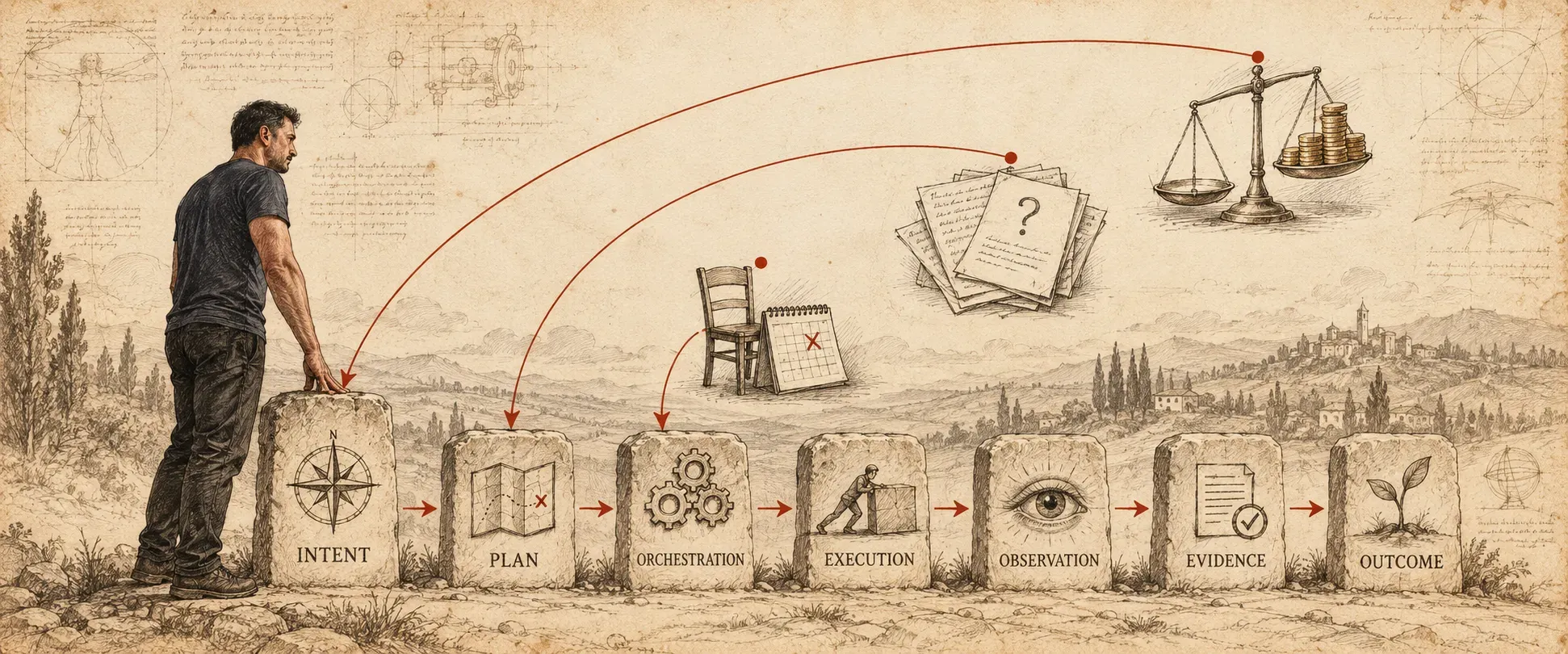
Three different events, three different destinations. They are not levels of a hierarchy; they differ in what they change. None of them goes back to observation: knowing that something happened does not tell the organization what should change.
Before an OrgOS, all three of these routes ran through the same place: whoever was paying attention. Usually, the founder.
State, not memory
When I started this, my intuition was that an organization full of agents would need good memory. I now think that is incomplete.
Memory answers: What happened before?
Organizational state answers: What do we currently believe to be true, and why?
Suppose an agent completed a task yesterday. Another system still shows it as open. A person knows it is done. Which version is the organization operating from? Without an explicit answer, the real source of truth is whoever happens to remember. That is exactly how the founder becomes infrastructure.
So state cannot live inside a conversation, inside an agent’s context window or inside one person’s head. It has to outlive all three. And it needs provenance. The organization should not only know this task is complete. It should be able to say why it believes that.
In simplified form, an observation from the churn example might be stored like this:
observation: support-analysis-completed
about: work-unit/analyze-support-history
claim: "Analysis complete: 41% of churned accounts opened integration tickets in their last 90 days."
observed_by: agent/support-analyst
occurred_at: 2026-09-14T16:02Z    # when it happened
recorded_at: 2026-09-14T16:05Z    # when the organization learned it
evidence:
  - report/churn-support-analysis-v1
  - query/tickets-churned-accounts-90d
status: observed                   # not yet verified by a person
unknown:
  - whether integration tickets cause churn or merely precede it
This is an explanation, not our schema; the real model has more structure and different names. But the essential properties are here: the claim is separate from who made it, when something happened is separate from when the organization found out, the evidence is attached rather than implied, and what remains unknown is written down instead of silently filled in.
That last line matters more than it looks. The most dangerous moment in an organization is not when it lacks information. It is when it quietly treats a correlation as a cause, a draft as a decision, or an agent’s report as a verified fact. So we do not know has to be a state the system can hold. Behind records like this, an append-only history of events can preserve what the organization learned and when, without pretending that sequence alone proves causality.
Transitions that should not need anyone
A persistent record of reality is necessary, but not enough. Most of what I used to do by hand was not remembering state. It was moving the organization from one state to the next. So the second half of an OrgOS is the transitions: the rules that say, when this becomes true, that should happen.
When the support analysis is recorded as complete, the work unit that depended on it should become ready. When a work unit has been waiting on something that already happened, it should wake up, or the system should say clearly why it cannot continue. None of this needs judgment. All of it used to need me.
The harder question is which transitions may happen automatically. My current answer is that authority is exercised in advance, not only at the moment of the decision.
A person with authority sets the boundaries. Tactical adjustments inside an approved plan may proceed on their own. Changes that alter the plan’s scope or cost wait for its owner. Anything that touches the intent, commits material resources or cannot easily be undone waits for an accountable human. The system’s job is not to decide what is important. It is to represent the boundaries people have established, act when a transition clearly falls within them, and escalate when it falls outside them, or when the boundary itself is uncertain.
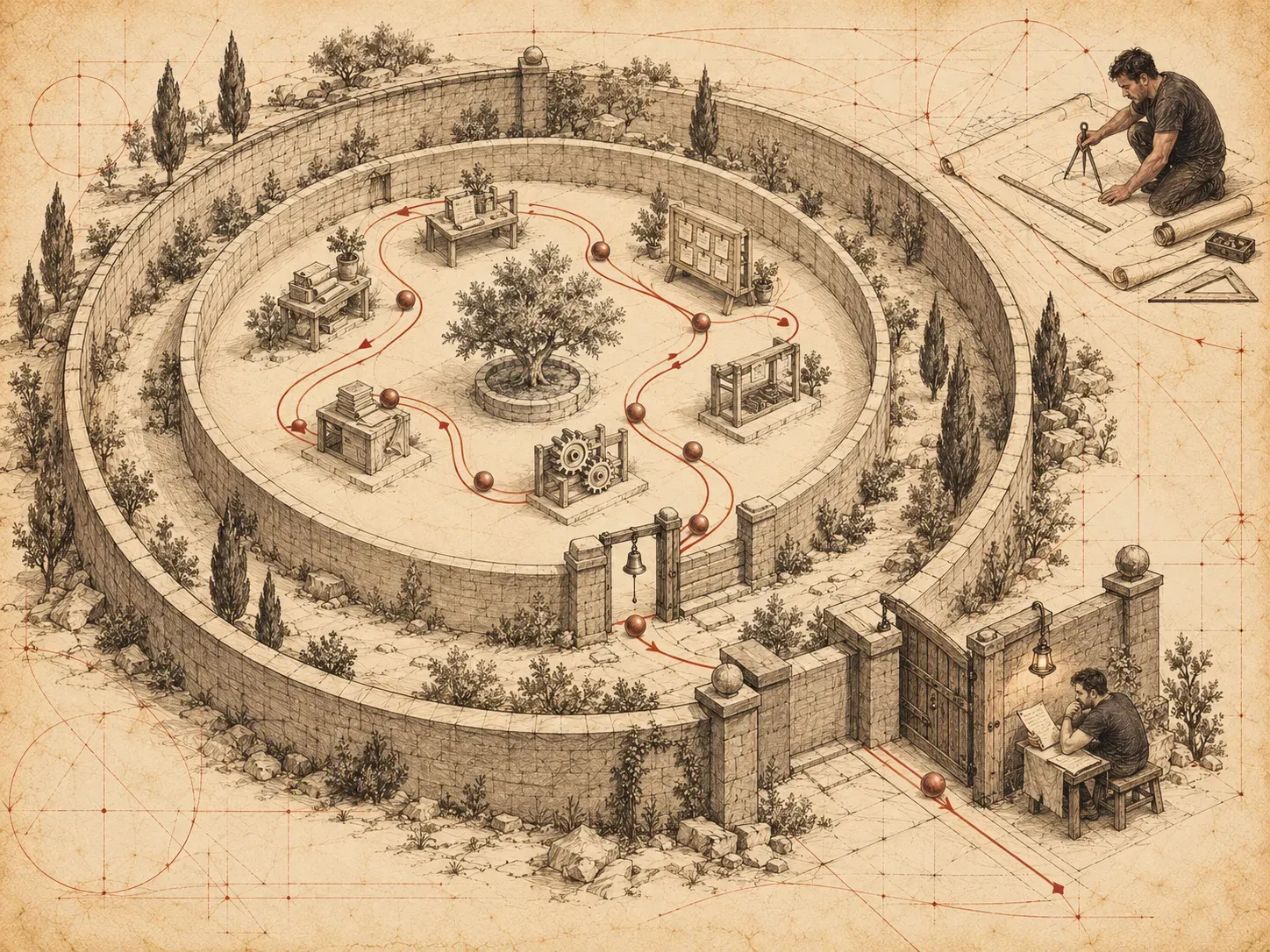
That is the distinction from the first essay, turned into something a system should be able to enforce: human authority is not the same as human intervention. I still decide what to pursue, what to commit to and what risk to accept. I just stop being the scheduler, the message bus, the retry mechanism and the reconciliation process. Those roles are not leadership. They are middleware.
Authority can be exercised in advance. Continuity should not wait for someone to remember.
A morning, before and after
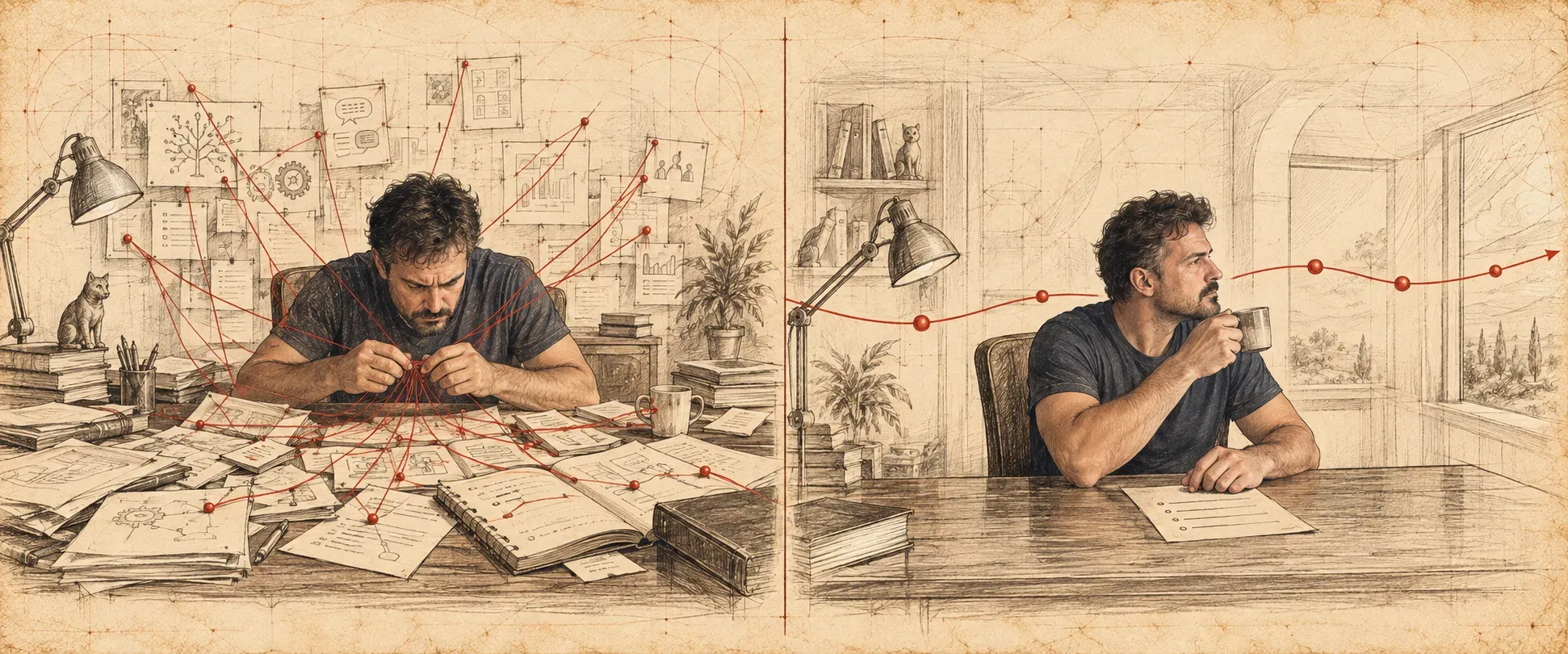
The clearest test for me is how a day starts. Before, I would open Slack, GitHub, email, the project tracker and several AI conversations, and rebuild the organization by hand: what changed, what finished, what is blocked, what should happen next.
With an OrgOS, the organization should already know what it is pursuing, what is in motion and which transitions are waiting on someone’s authority, and why. What reaches me should mostly be what actually needs me.
Where the model is still unclear
None of this is a finished architecture, and some distinctions that look clean on paper are much less clean in real work.
The boundary between tactical and operational feedback is the clearest example, and I saw it recently in something as ordinary as billing.
On 30 September we settled that Lucimark’s SaaS pricing would be based on screens alone. Two minutes after that change merged, the next piece of work was opened inside the same logic: a recurring per-screen price in Stripe. Three days later, Partner Portal work introduced an immutable ledger of the capacity allocated to partners’ customers, calculating screen-days. It was explicit that it changed no real billing: shadow metering, an observation of allocated capacity. As it was hardened, it stopped being only about how to charge per screen and began to define what an observable economic unit is.
Nowhere in the records does anyone say the plan has changed. My reading, and it is only a reading, is that this is the grey zone between the two loops: work that looked like refining the implementation began to produce a new definition of the economic object the plan has to consider. Nothing in the system said when a discovery like that should travel back from orchestration to the plan.
The blur is useful. The goal is not a theoretical machine. It is to observe where continuity breaks, understand why, and build the smallest system that carries the organization across.
The model will change. It probably should.
What it is
But one principle already feels durable.
An organizational operating system is not the thing that does all the work. It is the thing that keeps the organization coherent while the work is being done.
It remembers what the organization is trying to make true. It knows what has happened, and why it believes it. When reality changes, it routes that change to the place where the organization can actually respond: the orchestration of current work, the plan, or the authority that decides whether the intent still holds.
That is also why I no longer define an OrgOS by its interface. If the dashboard, the chat and the API all disappeared and the organization still knew what it is doing and why, the system would still exist. If a beautiful dashboard survives and all of that lives in someone’s head, it does not.
Everything else is an interface.
A question to take with you
Which of your organization's transitions happen only because someone remembered to make them happen?