About
I build systems with AI agents. Then I write about who should govern them.
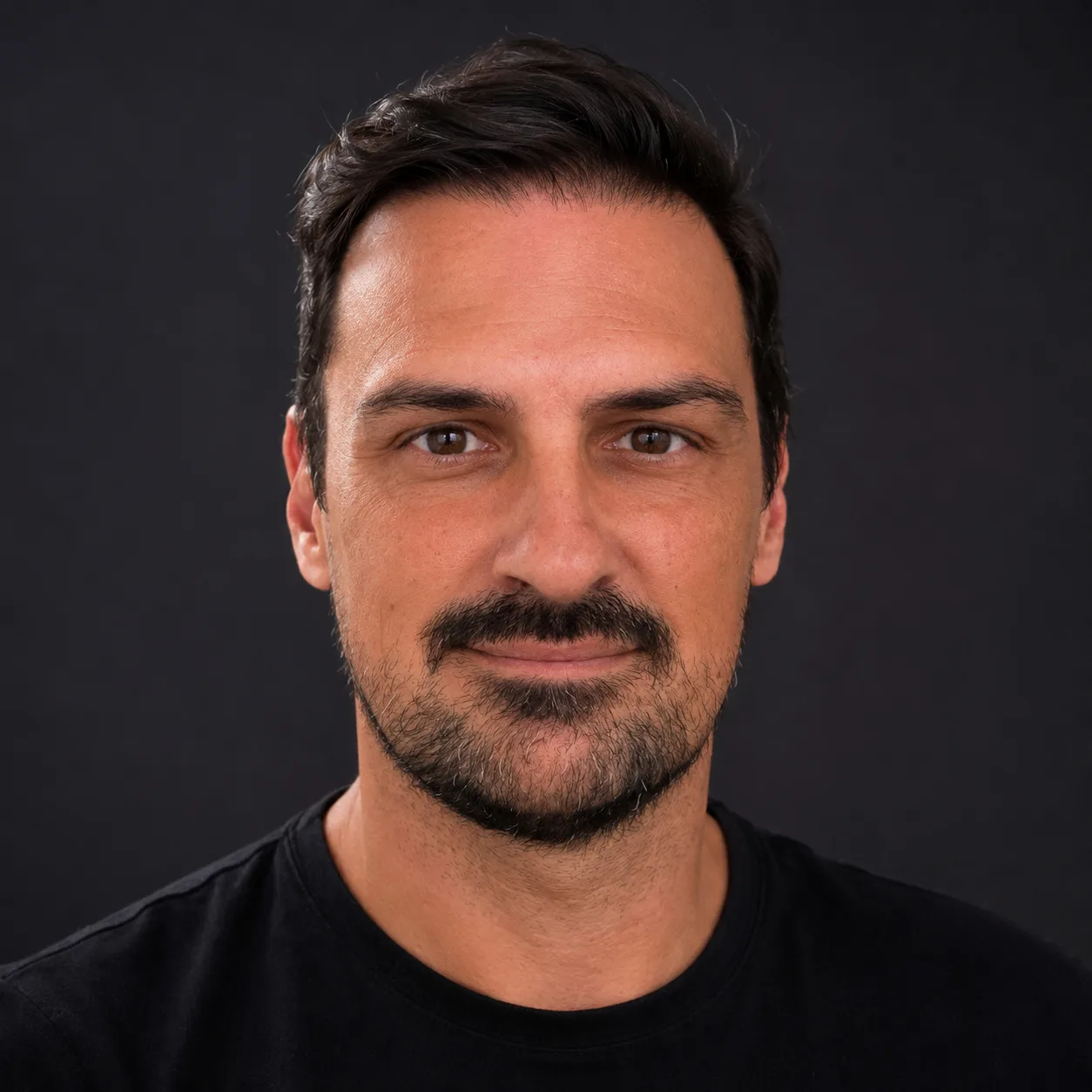
Paulo R.
- Governed AI agents
- Conversational agents
- Founder sovereignty
- Organizational continuity
- Authority and delegation
- Self-organization
I’m Paulo R., a systems architect and the founder of Lucimark. I’ve been writing software and designing systems since 2016, and leading small teams for just as long. Before that, I was a communications and information systems officer, a PhD researcher in self-organizing radio networks, and a project manager on a border-surveillance program. More recently, I spent several years at LeanIX and SAP, between Cologne, Brasília and São Paulo, building enterprise SaaS and, for the last three of them, working with AI/ML.
Since September 2026, at Lucimark, I build infrastructure for companies that operate networks of digital screens. Today it runs 410 screens across 8 tenants.
Much of that work is now done by AI agents. That’s why I’m building OrgOS: a way of running a company where agents with defined roles do the work and every decision is recorded, while authority stays with a person. Agents can execute. They don’t decide what the company is for. Some of it already runs, some is in testing, and some is still a hypothesis. I try to say which is which.
I’m also building Tredane, a platform that organizes customer conversations and appointments for aesthetic clinics over WhatsApp. There I design conversational agents: deciding what a language model may interpret, what must come from the clinic’s own records, and what only the customer or a person on the team can authorize. The model is one component among several, and most of the work is deciding where it belongs. I write about that in What the Model Is Allowed to Write.
The question underneath all of it is simple to state and hard to answer: how do you delegate execution without giving away authority?
Away from the keyboard, I’m usually sailing, on a motorcycle trip, somewhere in nature, reading, or training.
Why Opus Naturalis
Opus Naturalis is where I record what I discover while building.
I write about software, product, organizations and decisions — including hypotheses that fail, problems that change shape and ideas I still don’t know how to resolve. I want to preserve the path between a question and what experience allows me to understand.
This space follows that work over time: what I’m creating, what I’m learning and how it changes the way I think.
Reading counts
When you spend real time with an essay and scroll through most of it, the site records one anonymous read for that work (English and Portuguese share a counter). It stores a daily aggregate by country — derived from the network edge, never from a cookie — and a short-lived hash so the same visit is not counted twice in a day. No account, no fingerprinting library, no third-party analytics script for this. Counts stay private until a piece has enough reads to show without identifying anyone.